How to Connect Reading to Personal Experiences
Reading Comprehension Strategy Serial: How To Teach Making Connections in the Upper Simple Classroom
Teachers know that reading doesn't just consist of reading the words on the folio. Comprehension doesn't just magically happen. In fact, experts have come up to hold that for real comprehension to take place, readers employ i or more than strategies to aid in their comprehension of a text. These strategies include: Making Connections, Asking Questions, Visualizing, Predicting, Inferring, Determining Importance, and Synthesizing
As seasoned readers, adults use these reading strategies without much effort, just young readers need to be explicitly taught what these strategies are and how to use them. Overtime, readers will learn to weave in and out of these strategies to fully encompass the text that they read.
At the upper elementary level, students take probable been introduced to all vii of these reading strategies, but they even so need isolated instruction on each strategy throughout the school year. Of form, once a strategy is taught, information technology needs to exist reviewed, retaught, and continuously proficient.
Many teachers would agree that making connections is 1 of the easiest strategies for students to master just considering students are probable already doing information technology without much effort. In this post, I will walk y'all though the basics of what the strategy is and how to effectively teach it to your students
Pssst…Want a super engaging and interactive style to have students practice making connections?
LINKtivity® Interactive Guides are EXACTLY what y'all need to brand learning fun & attainable for all!
Get access to the Making Connections LINKtivity® (+60 others and counting!) within of LINKtivity® Learning - an all-access laissez passer to our unabridged vault of LINKtivities!
Below are the dissimilar categories within this post to assistance you leap to exactly what you lot need! Click on each category title to navigate in that location directly:
<< Back to categories
what you demand to know before education the MAKING CONNECTIONS reading strategy:
Making connections is a critical reading comprehension strategy that helps students make meaning of what they are reading. When students make connections to the texts that they are reading, it helps them to make sense of what they read, retain the data better, and engage more with the text itself.
Students can make connections between:
-
the text and themselves
-
the text and some other text
-
the text and the world effectually them
TEXT-TO-Self CONNECTIONS:
These are connections where students connect what they are reading to personal experiences or knowledge. Students with a wide range of experiences will often exist able to make more than insightful and circuitous connections. Students with more express experiences may struggle to make connections or create vague, general connections.
Example of Text to Self: "This story reminds me of a vacation that I took to the ocean, simply like the main graphic symbol."
TEXT-TO-TEXT CONNECTIONS
These connections are made when a pupil can connect what they are reading to other books that they have read or listened to before. They may make connections that prove how the books share the same author, have similar characters, events, or settings, are the aforementioned genre, or are on the same topic. A solid text to text connectedness occurs when a pupil is able to apply what they've read from one text to some other text.
Case of Text to Text: "I read another book almost spiders that explained that spiders accept venom and in this book, I am learning about the top ten unsafe spiders of the earth."
TEXT-TO-Earth CONNECTIONS
These are connections where students connect what they are reading to real events (past of present), social problems, other people, and happenings going on in the globe. Students larn about the world from what they hear on Tv set, movies, magazines, and newspapers. Effective text to world connections happen when students can use what they have learned through these mediums to enhance their understanding of the text that they are reading.
Instance of Text to World: "I saw on the news virtually how water pollution was affecting marine animals, and in this book I am learning about why pollution can make a marine animal sick.
All 3 of these connections are most meaningful and effective when students are able to brand deep, complex, and insightful connections to the text, rather than vague, full general, or superficial connections.
<< Back to categories
MODELING MAKING CONNECTIONS
Although many students observe making connections an easier strategy to master than some others, it does not ever come naturally to all students, specially those with limited experiences. Therefore, you will need to spend time modeling the use of each type of connection through read aloud texts and written responses.
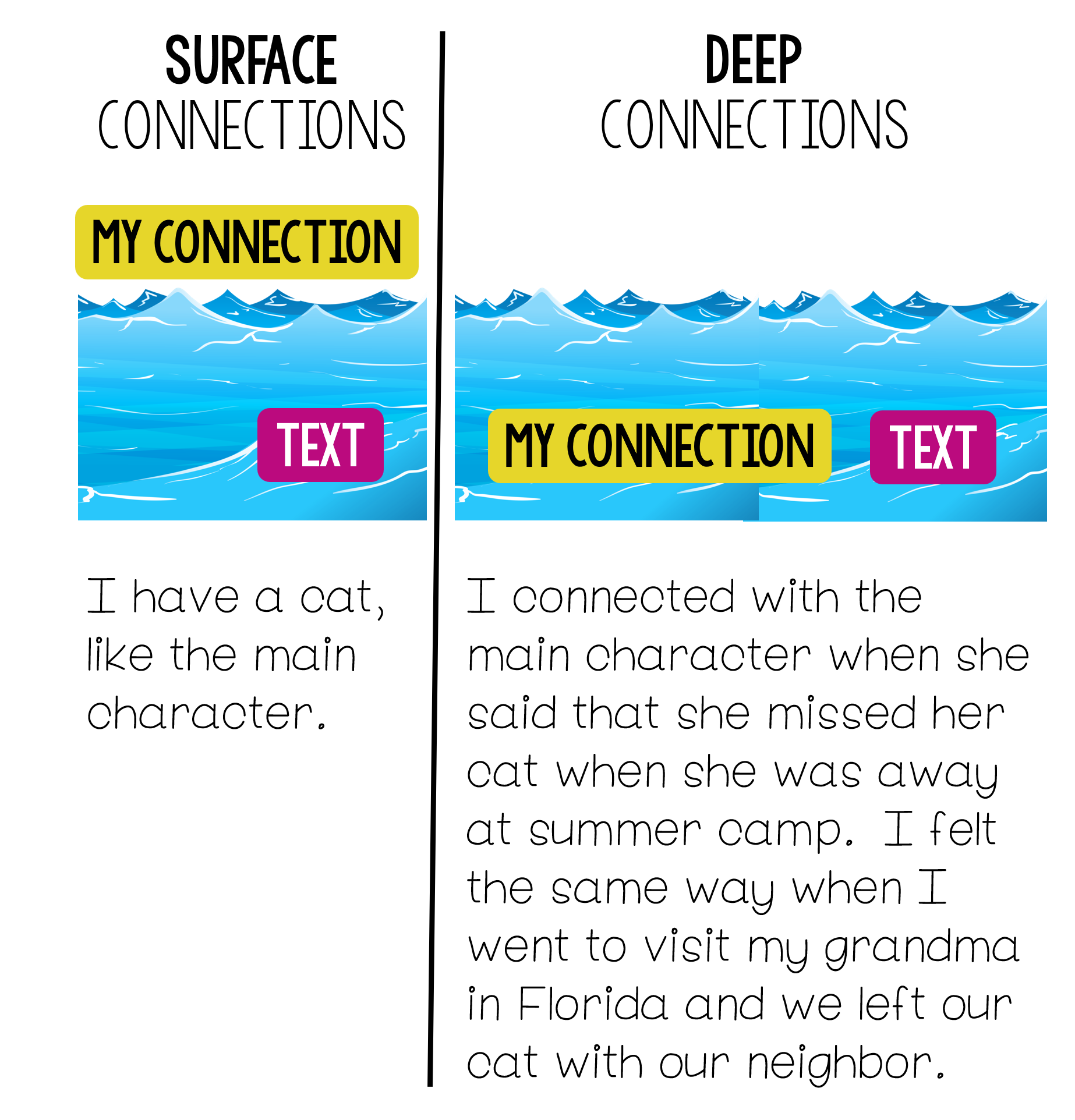
Typically, the easiest type of connexion for most students to make is the text-to-self connection. Start by using read-aloud texts that y'all are confident most, if not all students will be able to have some sort of connection with. Model your own connections and invite others to share theirs. Talk over the difference between deep connections, and surface connections. The graphic on the right provides an example of what this might look like.
Using a variety of prompts to guide students in making text to self connections tin can assist focus a student's idea procedure or assistance struggling students. These prompts piece of work bully when making both oral and written connections:
-
What does this remind me of in my life?
-
How is this like to my life?
-
How is this different from my life?
-
Has something like this always happened to me?
-
How does this chronicle to my life?
-
What were my feelings when I read this?
Text-to-text connections are the second blazon of connection that about teachers cull to teach. Choose ii texts that you know students volition exist able to easily identify similar topics, characters, or events. For case, you might read a book about a specific topic, and so a fiction poem on the same topic. Plan out the connections that you'd like to model for you students alee of time. Use the post-obit prompts to help guide students:
-
What does this remind me of in another book I've read?
-
How is this text similar to other things I've read?
-
How is this dissimilar from other books I've read?
-
Accept I read near something similar this before?
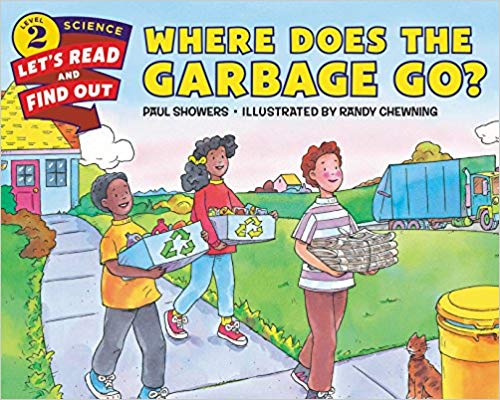
The most challenging connectedness to teach is text-to-world connections. Choose books that have characters or are about topics that will easily lend itself to text-to-earth connections. For example, the book Where Does Garbage Become? (view here) would be an easy volume for students to connect to a globe issue. You lot tin can discuss the importance of earth conservation, talk over concerns such water pollution…etc. Use the following prompts to assist guide students in text-to-world connections:
-
What does this remind me of in the real world?
-
How is this text similar to things that happen in the real world?
-
How is this different from things that happen in the existent earth?
-
How did that role relate to the globe around me?
<< Dorsum to categories
PRACTICING MAKING CONNECTIONS:
CREATE Unproblematic VISUALS TO REMIND STUDENTS TO Make CONNECTIONS:

Students will demand ample time to exercise this strategy with y'all in guided reading or strategy groups also equally with their independent books. When beginning practicing the strategy on their own, information technology helps for students to have a unproblematic reminder of the strategy in front of them while they are reading in both small groups besides as individually.
Something as uncomplicated as a bookmark that students can refer to while they read is the perfect friendly reminder to make connections while they read.

eight free Reading Strategy bookmark!
Grab these Gratis student bookmarks to help your students use reading comprehension strategies while reading.
There are a total of 8 bookmarks that explicate reading strategy in child-friendly language and is the perfect reference for students to use during independent or minor-grouping reading time.
In addition to personal reminders, Exist sure to create anchor charts with your students or place up posters for students to refer to while learning this strategy. The visuals of the posters and/or anchor charts along with a students bookmark or something like will help to keep the reading strategy height of mind.
You lot May Also Like to Read: x Anchor CHARTS TO TEACH STUDENTS TO MAKE CONNECTIONS
Apply DIGITAL LINKtivity® INTERACTIVE LEARNING GUIDES
If you've been with me for a while, and then y'all know my go-to method to teaching new content to students is LINKtivities! They work great for private practise and fifty-fifty for centers. In the making connections LINKtivity, students learn this reading strategy in a diversity of ways. Watch the video beneath for a sneak-peek!
Hither's how it works:
First, students scout a short animated video prune that rapidly catches their attention with fun doodles and images. The clip introduces what the strategy is and how readers use it.
Then, students read a story along side their virtual "reading buddy" and explore the strategy in activeness. The students click on different speech bubbles throughout the story to see what connections their reading buddy is making.
Finally, students get to practice the reading strategy on their own past reading three more than loftier-interest brusque stories in a diverseness of genres specifically written for the making connections reading strategy. While reading, students tape their own connections on a simple recording sail.
Take STUDENTS RECORD THEIR CONNECTIONS:
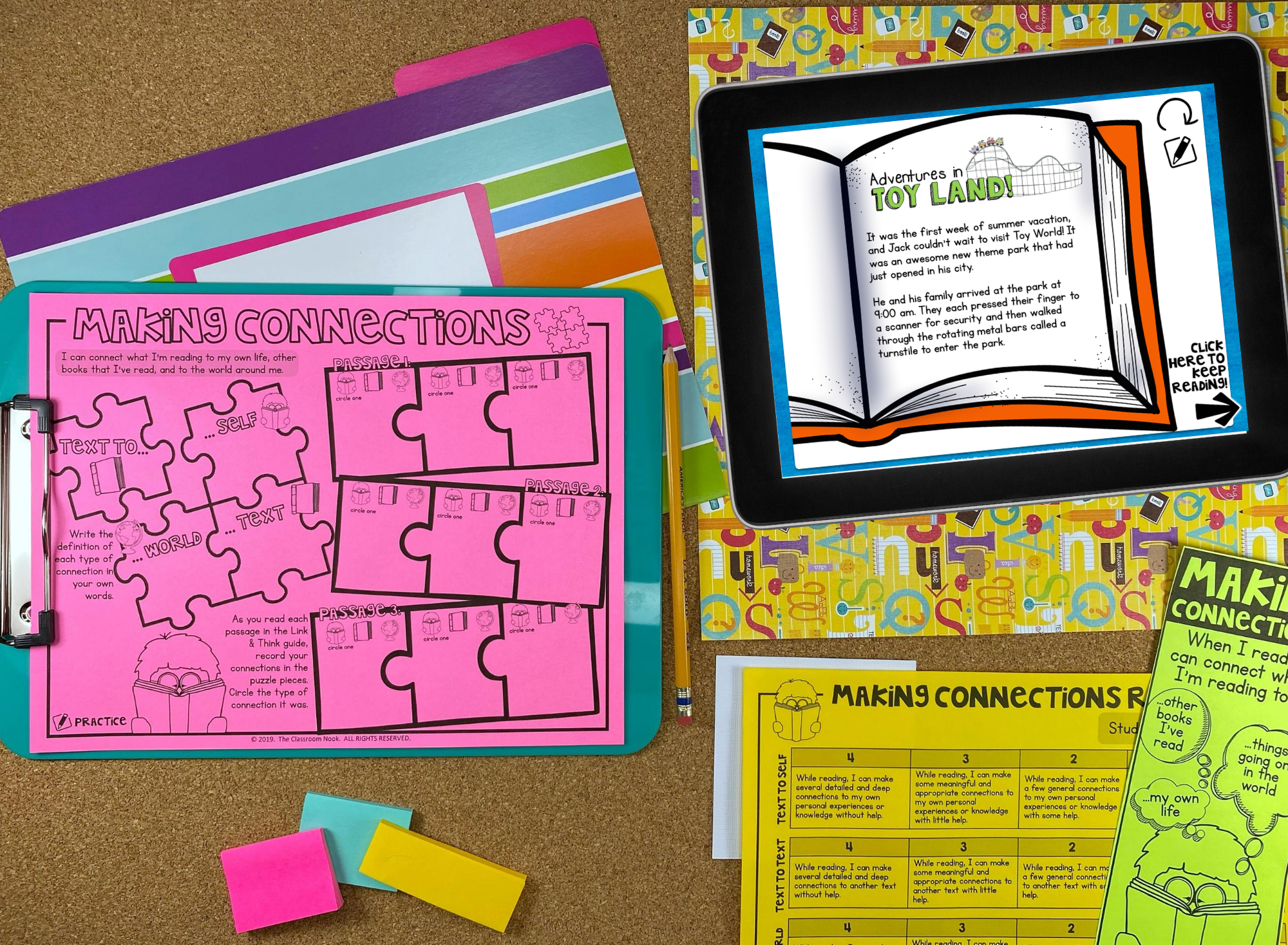
Similar I mentioned higher up, it'south of import, peculiarly when first starting to make connections, for students to actually tape their connections on paper or digital grade. Students won't use all three types of connections all the fourth dimension, just it helps to provide students with a unproblematic recording sheet where they tin use words and/or pictures to illustrate connections that they do make. This non only forces students to stop reading, call back, and brand connections to their book, just it as well allows yous to see how see how well students are applying the strategy on their own. You'll also exist able to see which types of connections each pupil makes most ofttimes, and which ones they neglect or struggle with.
HAVE STUDENTS ORALLY SHARE THEIR CONNECTIONS
One of the best ways for students to get ameliorate at making connections is to hear other students' connections. While teaching this strategy, exist sure to close your reading block each day with a time of sharing where students can orally talk over the connections that they fabricated while reading. Continue to model and share your own connections then that students brainstorm to hear what makes a great connection.
<< Back to categories
assessing your students on making connections

Assessment is an important component to effectively teaching making connections. Your assessments and observations will inform your instruction. Be sure to keep running notes of your students' use, or lack of utilize, of the making connections strategy in both individual conferences as well equally in reading groups.
Keep track of how deep and meaningful the connections are. Are the connections authentic and complex? Or are they forced, surface-level, and superficial? A simple observation canvas like the one above in orange will inform your future instruction as well as what you might want to focus on during individual reading conferences.
Students likewise need to be aware of how they are doing with making connections. A kid-friendly rubric (see above) volition assist break down what y'all are looking for in each type of connection. Articulate guidelines on what makes a great connexion will aid students better their connections overtime. Give guidelines for each individual blazon of connection rather than clumping them all together. This will help you lot and the student focus on his/her strengths every bit well equally areas of improvement as it relates to making connections.
<< Back to categories
Resources for Making Connections
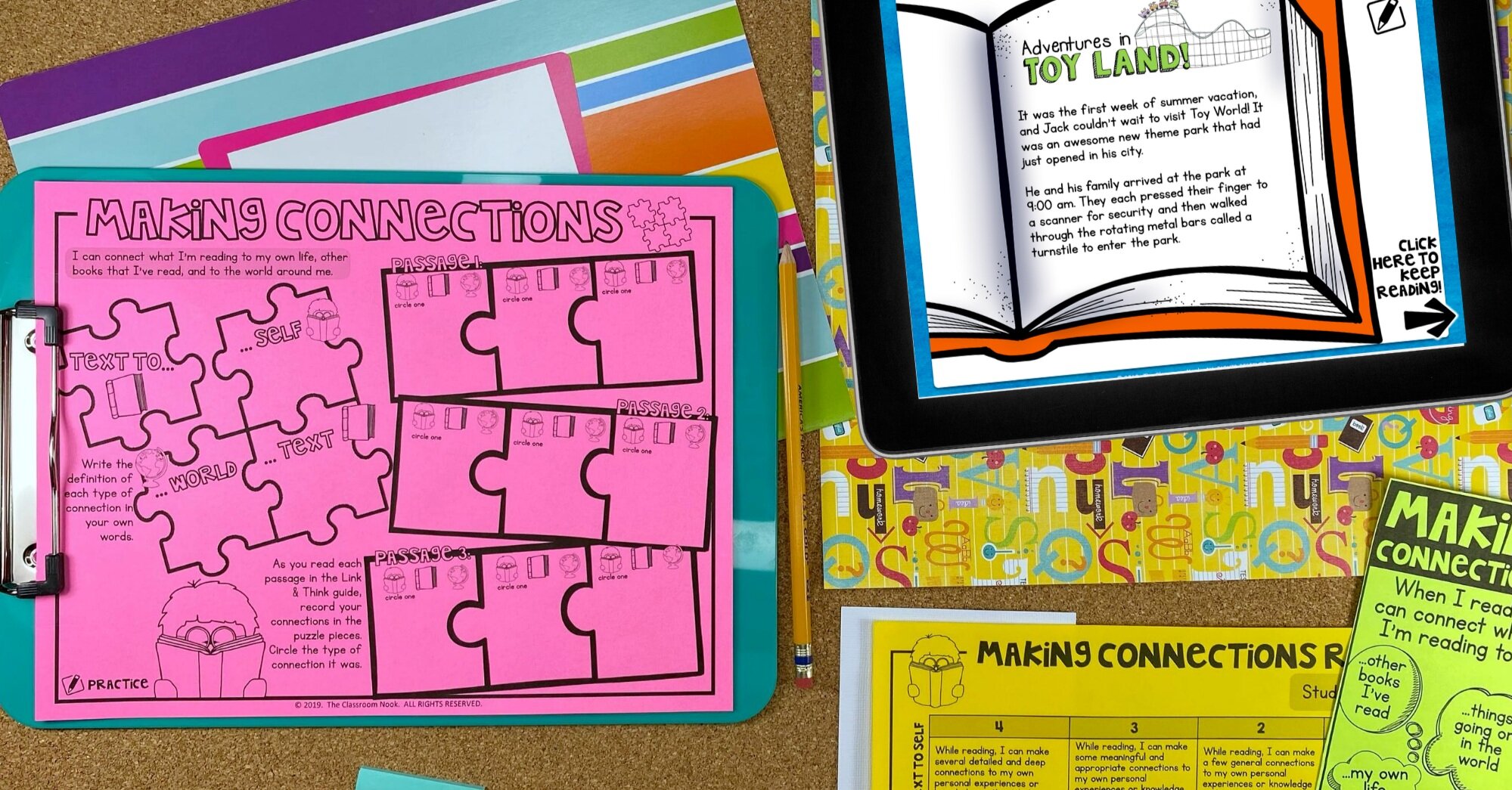
Want to get your hands on the Making Connections LINKtivity®?
Join the LINKtivity® Learning Membership and outset using this set-to-go resource for making connections that includes:
-
a teacher guide
-
a pupil LINKtivity
-
a educatee recording sheet
-
a student-friendly rubric
Get admission to the Making Connexion LINKtivity® PLUS all the other reading comprehension strategies inside of LINKtivity® Learning - an ALL-ACCESS pass to every unmarried LINKtivity® created (INCLUDING all 7 reading strategy LINKtivities!)
Cheque out the other posts in this series
Source: https://www.classroomnook.com/blog/making-connections
0 Response to "How to Connect Reading to Personal Experiences"
Post a Comment